Prove what the road was like before.
After a flood or storm, every funding claim and every insurance conversation asks the same question: what condition was this road in before the event? Because survey frames are captured on every ordinary drive, the answer already exists, datestamped, before anyone knew there would be an event to argue about.
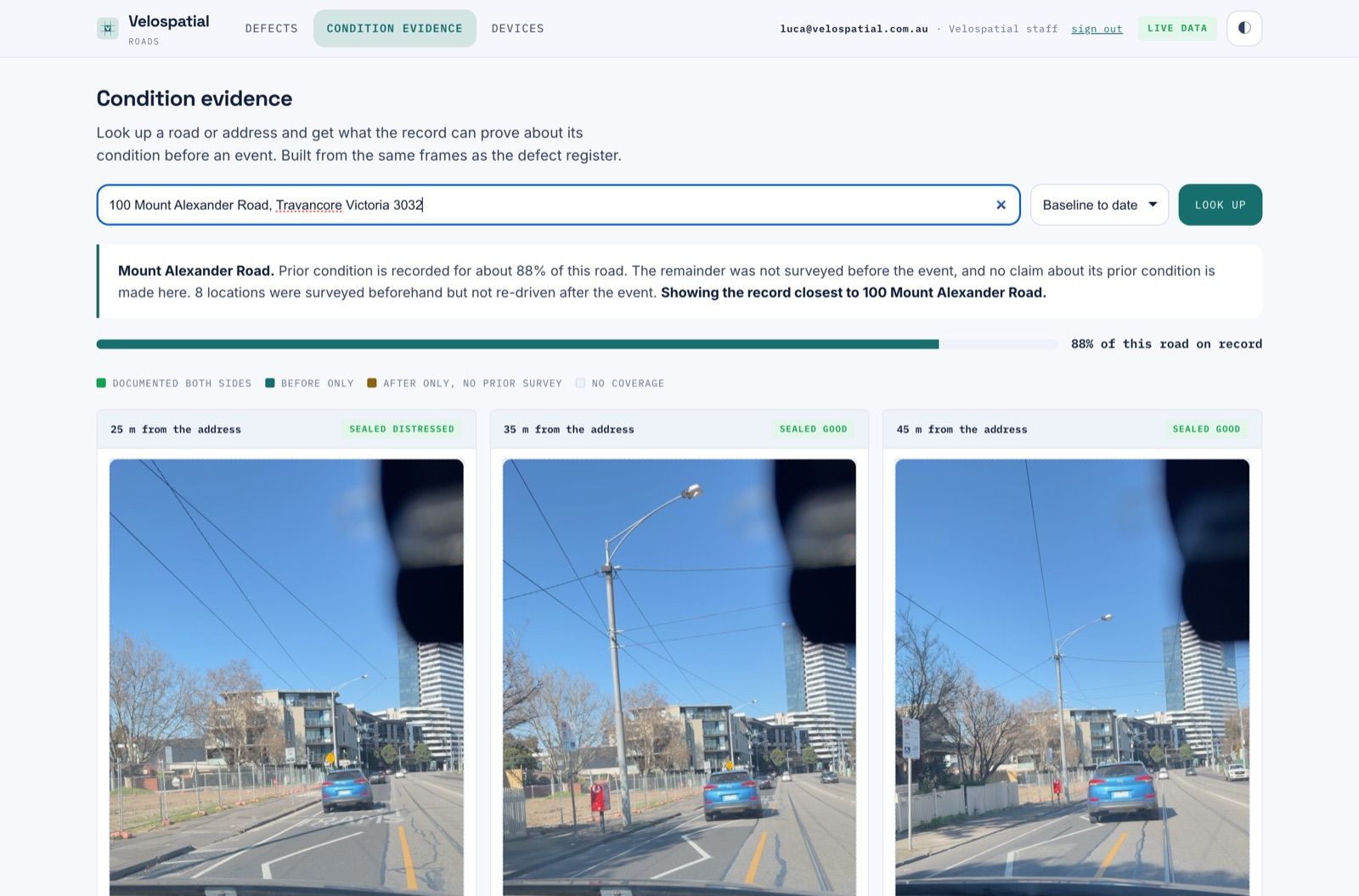
Look up a road, get what the record can prove
Search a road or an address and pick the event. The pack pairs the last frame before the event with the first frame after it, stretch by stretch, and opens with a plain-language coverage statement: how much of the road has prior condition on record, and how much does not.
Every gap is stated rather than omitted. A stretch nobody drove before the event says so, and no claim is made about its prior condition, because a pack that silently skips its gaps reads as evidence the road was sound there, and it is evidence of nothing.
Export view to come.
The PDF pack carries the coverage statement on its first page.
Built for the people who audit you
Disaster recovery funding arrangements ask councils to evidence pre-disaster condition, and an auditor's first move is to test whether the record was made before the event or assembled after it. These frames carry capture time and position from the day they were taken, on drives that happened for other reasons.
The export is being built now. It will be a single document per road per event: coverage statement first, then the before and after pairs with their dates, then the gaps.
Deterioration timeline to come.
One fault, every observation, graded across months.
Was it the flood, or was it failing anyway?
Because the register keeps every observation of every fault, the record can separate damage that appeared with an event from deterioration that was already underway. That distinction is the difference between a restoration claim and a maintenance liability, and it is exactly the question a record built after the event cannot answer.
Where the record cannot make the call, it says so. Damage recorded with no prior survey is labelled that way, never attributed to the event by default.
The best time to start the record was before the event.
The second best time is now. Every drive from the day you start builds the baseline the next event will be judged against.